
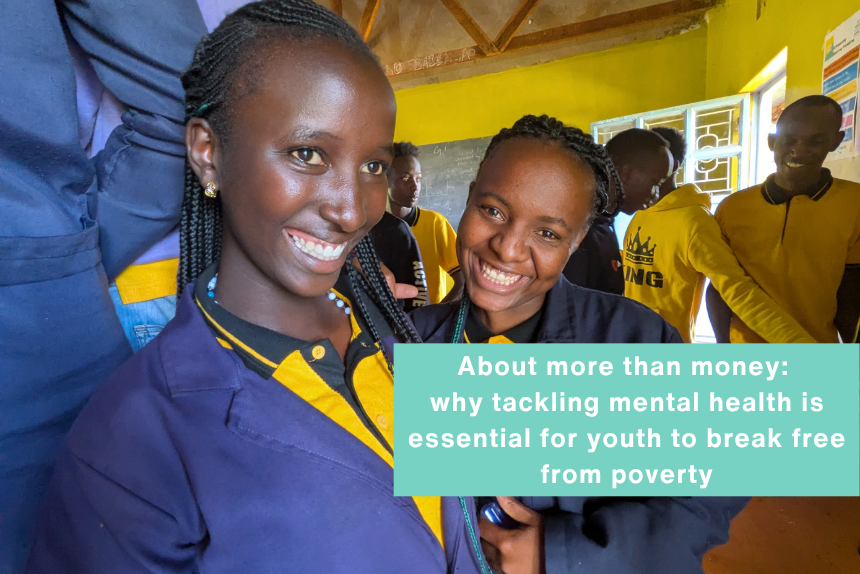
We refuse to ignore the mental health needs of the young people we work with.
If ignored, mental health struggles can quietly derail a young person’s education, confidence, and sense of hope.
If ignored, they can cut short futures before they’ve even had a chance to begin.
From the very beginning of our pioneering Seed of Hope programme over 20 years ago, trained counsellor and now long-serving Programme Manager Florence Olwenge recognised that mental health support must be a core part of the offering.
Florence understood that skills training and practical support alone, while key to a young person earning a safe, secure income, could be rendered useless if a young person is silently battling mental health or wellbeing struggles.
Learning a new skill like Motor Vehicle Mechanics or Fashion and Fabric Design requires focus, regular attendance and effort. Setting up a business or securing a job after graduating also requires confidence and dedication.
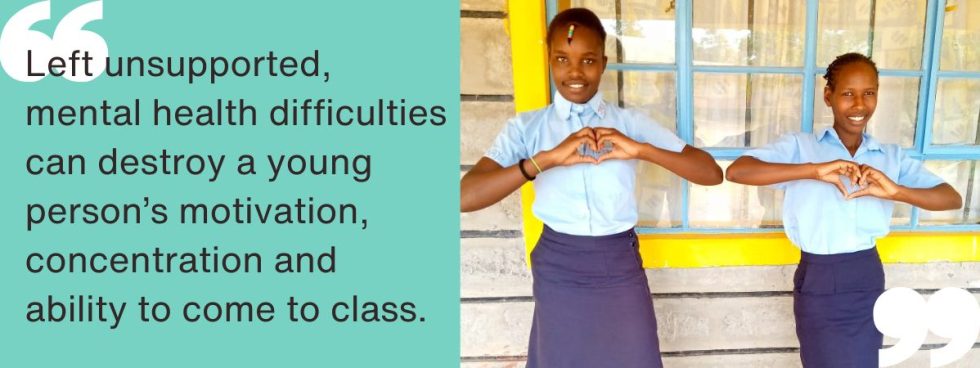
Poverty, inequality and/or exploitation are in themselves traumatic experiences. Many students have worried about the availability of food or the family budget for much of their lives. For other students, there is complex emotional disruption at home, caused by the strain of poverty and inequality on their families and wider community. In Murang’a county for example, where our Seed of Hope Kariti centre is based;
- Alcoholism affects 45% of families*
- Domestic violence affects 54% of women aged 15 to 49, 20% higher than the national average**.
The complex, layered trauma caused by these combined factors means many young people that enrol at Seed of Hope are physically or emotionally unable to complete, or even access, educational or training opportunities. They are locked out of the qualifications and skills needed to earn safe, stable incomes and without mental health support would be left vulnerable to exploitation in their efforts to survive.
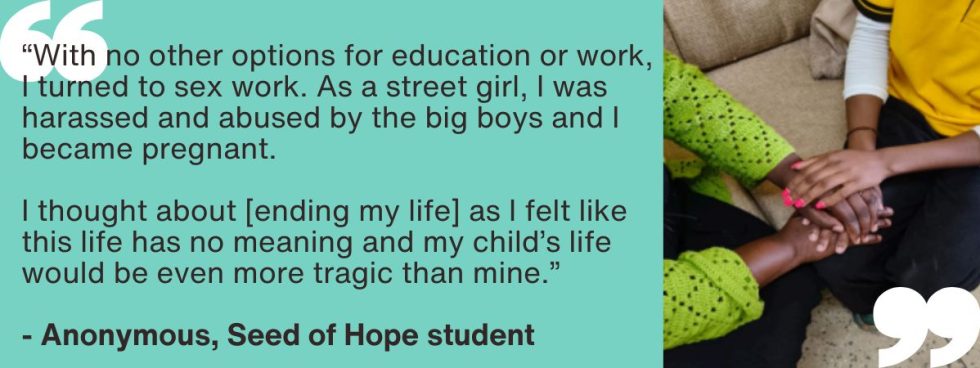
Girls and young women are disproportionately impacted. Poverty can mean they’re forced into early marriage and motherhood, or they face gender-based violence and exploitation. One anonymous Seed of Hope student told us:
We can’t expect a young person to focus on skills development, entrepreneurship, or career planning if they’re in emotional crisis or battling trauma alone.
That’s why every Seed of Hope student has access to:
- Free one-to-one counselling with trained professionals
- Group wellbeing sessions that create safe spaces for sharing and healing
- Workshops and peer support covering topics such as gender allyship, Sexual, Reproductive Health and Rights (SRHR), peer pressure and substance abuse
Our 2024 survey of students that had therapy at Seed of Hope shows that, before starting, 86% had wellbeing scores showing ‘possible’ or ‘probable’ depression or anxiety. After therapy, this had dropped to just 5% of students. Our mental health and wellbeing support is not an add-on. It’s a core part of our model — if young people are to have the best chance of sustainably breaking free from the cycle of poverty, we must take a holistic approach to supporting them.
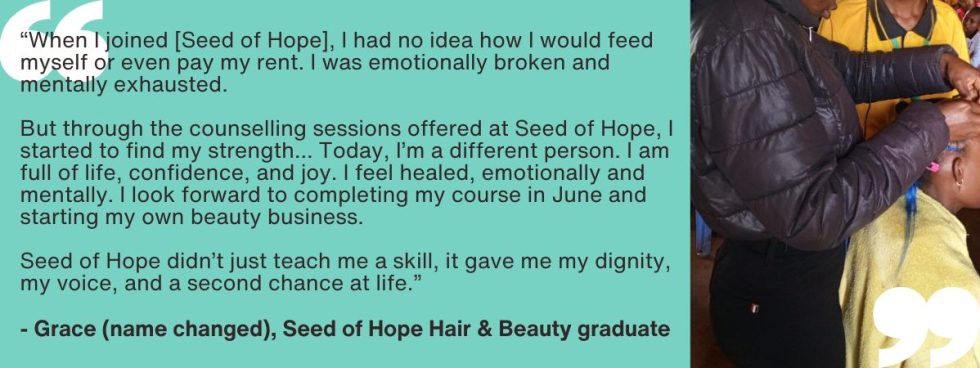
We support students’ emotional wellbeing, self-worth, and ability to imagine a better future. For Grace (name has been changed), joining Seed of Hope as a Hair & Beauty student transformed not just her skillset, but her entire sense of self:
What you can do next
If, like us, you’re serious about breaking cycles of poverty with young people in Kenya, here’s what you can do next:
- Share this article, to help raise awareness of our pioneering Seed of Hope programme
- Make a regular gift. Just £15 a month could pay for a counselling session for a student
- Join our mailing list to keep up to date with the incredible impact we are having together.
- Sign up to our virtual Impact Showcase event, to hear for yourself stories and statistics from our Kenyan-led partner!
Because mental health is not a luxury. It’s a lifeline.
*National Council of Population Development, 2023, **Kenya National Bureau of Statistics, 2022
Recent Comments